AI, Automation & Software for Healthcare Providers
Every enquiry reaches the right department, first time.
Hospitals, multi-site provider groups, diagnostic centres and care providers handle thousands of calls and messages across departments. We build the chatbots, voice agents, automations and software that answer routine enquiries, route referrals and requests to the right team and keep records in step, with clinicians making every clinical decision.
Why Choose GetAIChatBots for Healthcare Providers
Healthcare organisations run on routing: the right question to the right department, quickly, with the details attached. A switchboard that is busy with routine calls slows down the ones that matter. GetAIChatBots builds the chatbots, voice agents, automations, CRMs and custom software that answer routine enquiries, route requests to the right team and keep records in step. Clinical decisions always stay with your clinicians. We work remotely with hospitals, provider groups, diagnostic centres and care providers across the United States and worldwide.
Routine contacts slow down the ones that matter.
Patients and referrers call and message about hours, directions, appointments and paperwork, and each contact is passed between desks. Referrals are retyped, reminders depend on memory and managers build reports by hand from several systems.
The fix is rarely one tool. It is the right mix: a chatbot or voice agent that answers the routine contacts, automation that routes and records every request, and software where off-the-shelf stops fitting. Clinicians keep every clinical decision.
- Switchboard queues full of routine calls
- Requests passed between departments
- Referrals and reports handled by hand
Three steps from audit to launch.
Map your enquiry journey
We follow a request from first contact to resolution.
A short working session maps how calls, messages, referrals and reminders move through your organisation, where requests wait and which decisions must stay with clinicians.
- Channels and tools reviewed
- Boundaries for clinical topics agreed
- Quick wins agreed first
Build the right mix
Chatbots, agents, automation, CRM or software.
We build in short cycles with a demo each week, starting with the change that removes the most friction.
- Weekly demos
- Connected to your scheduling system and CRM
- Fixed scope in writing
Run and improve
We monitor, report and keep improving.
Each workflow and agent is monitored, with alerts and a regular review of what is working.
- Monitoring and alerts
- Regular reporting
- Handover and training
How we help healthcare providers
Six services, one team. Choose one to see how it works for healthcare.
AI Chatbots
Chatbots on your website, WhatsApp, SMS and patient portal that answer first, so your staff can look after the people in front of them.
- Information from your own sources
- Appointment change requests
- Referral and intake collection
- Handover to a person
AI Agents
Voice agents that cover the switchboard when lines are busy or the office is closed, and hand over to a person when it matters.
- Switchboard overflow
- Routine information calls
- Appointment request calls
- Urgent and clinical calls
Business Automation
Workflows that remove the copy-paste between your referral inbox, scheduling system and reports.
- Referral intake and routing
- Reminders and recalls
- Staff notifications
- Reports and capacity data
CRM Development
A CRM shaped around referrers, enquiries and departments instead of a generic sales pipeline.
- Pipelines that fit
- Referrer records
- Routing and reminders
- Reports and clean-up
Full Stack / SaaS
Custom software for when off-the-shelf tools stop fitting how your organisation works.
- Referral portal
- Staff knowledge tool
- Operations dashboard
- Integrations
Advisory & Growth
Clear advice before you build: what to automate, what to fix and what must always stay with a person.
- AI roadmap
- Boundary review
- Security review
- Product scoping
One team for the whole enquiry, from first contact to record
Patient contact is lost in the gaps: the call transferred twice, the referral missing a field, the reminder nobody sent. We build the chatbot, the voice agent, the automation and the CRM as one connected system, so a call, a message and a form all end up in one record with the right team. The line is clear: our systems answer, collect, route and remind, and your clinicians make every clinical, triage and diagnostic decision.
Book a Call ↗From first contact to updated record, handled.
We build six kinds of service for healthcare providers: chatbots, voice agents, automation, CRM development, custom software and advisory. They can be bought one at a time, and they are designed to work together.
What gets built first
Whatever removes the most friction: usually routine information enquiries, appointment-change requests and referral routing.
Where people stay in charge
Clinical questions, triage, results and anything urgent or sensitive. Systems handle the repetitive steps and hand over with the full history.
Works with your stack.
We connect everything to your scheduling system and records tools where they offer an interface, plus your phone system, inbox and CRM, and recommend the platform that fits how your team works.
Book a Call →Why Choose GetAIChatBots for Healthcare Chatbots
A healthcare chatbot answers routine questions from your approved information the moment they arrive, collects appointment-change and referral details and routes each request to the right department. GetAIChatBots builds chatbots and voice agents for hospitals, provider groups, diagnostic centres and care providers, connected to your scheduling system where it offers an interface. Clinical advice, triage and results always stay with your clinicians. We work remotely with clients across the US and worldwide.
Routine questions use up the lines that patients need.
Switchboards and department desks answer the same questions all day: where to park, who to call, how to change an appointment. Patients are transferred between departments, repeat their details and sometimes give up. Meanwhile calls that really need a clinician wait in the same queue.
A chatbot answers the routine questions from your approved information, sends each request to the right team with the details attached and hands clinical or urgent matters to a person.
- Switchboard queues full of routine questions
- Patients transferred between departments
- Requests arriving with details missing
Three steps from enquiry to launch.
Load your approved information
The bot learns your sites, departments and patient information from your own material.
You share the visitor and patient information you already publish: hours, directions, department directory and preparation notes. The bot answers from that material only and says so when it does not know.
- Sites and departments loaded
- Approved wording only
- Handoff rules agreed with your team
Answer and route
It replies at any hour and sends each request to the right department.
Routine questions are answered straight away. Appointment changes, referrals and billing questions are collected with the details the team needs and routed to the owning department.
- Routine questions answered
- Requests routed by department
- Details attached to each request
Hand over and follow up
Clinical questions go to staff, and patients get confirmations and reminders.
Anything clinical, urgent or sensitive is passed to a staff member with the conversation attached. Confirmations and reminders go out to patients who agreed to receive them, as information only.
- Staff alerted with full context
- Confirmation and reminder messages
- Opt-out in every message
What you get.
Information answers on web and WhatsApp
Patients and visitors get the same approved answer on every channel.
- Hours, directions and parking
- Department directory
- Handoff when a person is needed
Appointment change requests
Requests reach the right scheduling team complete.
- Department and date collected
- Contact details attached
- Routed to the owning team
Referral and intake collection
Requests arrive with the details your team needs.
- Required fields enforced
- Missing details asked for in chat
- Passed to the right department
Preparation and visit information
Patients know what to bring and where to go.
- General preparation notes you approve
- Directions and arrival information
- Reminders as information only
Reminders and follow-up nudges
Fewer missed appointments.
- Confirmation and reminder messages
- Easy confirm, change or cancel
- Sent only to people who agreed
Human handoff for clinical or urgent questions
Anything clinical or urgent goes straight to a person.
- Rules for what counts as urgent
- Full conversation passed along
- Emergency numbers shown
What AI chatbots do for healthcare providers
Chatbots on your website, WhatsApp, SMS and patient portal that answer first, so your staff can look after the people in front of them.
Information from your own sources
Visiting hours, directions, parking, department locations and preparation notes answered from material you have approved.
Appointment change requests
Patients who need to book, move or cancel are asked for the department and date, and the request goes to the right scheduling team.
Referral and intake collection
Referrers and patients send the details your team needs through a short guided chat, so the request arrives complete.
Handover to a person
Clinical questions, urgent matters and anything the bot is unsure about reach a staff member with the conversation attached.
A chatbot for information and routing, not for clinical advice
In healthcare, the line between helping and advising matters. Our chatbots answer from material you approve, collect details and route requests. They do not give medical advice, triage symptoms, interpret results or discuss individual treatment, and they say so and pass those topics to your staff. If someone describes an emergency, the bot directs them to emergency services. Reminders go only to patients who agreed to receive messages, with a simple way to opt out. We agree the boundaries, and how patient details may be handled, with you before we build, and write them into the bot’s instructions.
Book a Call ↗Routine answered, requests routed, clinicians left to care.
A healthcare chatbot is an assistant on your website, WhatsApp or patient portal that answers common questions from information you approve and collects the details for appointment changes, referrals and billing enquiries. Add a retrieval layer and it can answer from your own visitor and patient information, citing where the answer came from. Workflows then take over the reminders and record updates that normally depend on someone remembering.
What the bot handles
Information questions, department directory, appointment-change requests, referral intake, preparation notes and reminders. These are repetitive tasks with clear inputs and no clinical judgment involved.
Where people stay in charge
Clinical questions, triage, results and anything urgent or sensitive. The bot passes these to your staff with everything it has collected.
Works with your stack.
We connect the bot to your scheduling system, CRM and messaging tools, where they offer an interface, and recommend the platform that fits how your organisation already works.
Book a Call →The channels patients and referrers use to reach you.
People contact providers on whatever is quickest. We cover the channels below so an enquiry from any of them lands in one place with the details the right team needs.
Why Choose GetAIChatBots for Healthcare AI Agents
A healthcare AI agent answers the phone when the switchboard is busy, answers routine questions from your approved information, collects the details for the right department and passes clinical or urgent calls to a person. GetAIChatBots builds voice and chat agents for hospitals, provider groups, diagnostic centres and care providers, connected to your phone system and scheduling or CRM tool. Clinical decisions always stay with your clinicians. We work remotely with clients across the US and worldwide.
The switchboard is busiest when callers need it most.
General enquiry lines carry a long tail of routine calls, and queues grow in the morning and at shift changes. Callers hang up and call back, and after-hours calls reach a recording. Staff spend their day passing calls on rather than helping.
A voice agent answers every call, handles the routine information requests, collects the details for the right department and passes anything clinical or urgent to a person straight away.
- Callers queuing for routine information
- After-hours calls reaching a recording
- Calls transferred more than once
Three steps for AI agents in healthcare.
Define the call
We write the call around your sites, departments and escalation rules.
Together we agree what the agent says, what it asks and when it passes the call to a person. It answers from your own approved information, and says so when it does not know.
- Greeting, questions and handover rules
- Approved information loaded
- Voice and languages chosen
Connect phone and systems
The agent plugs into your number, department routing and scheduling system.
We connect your phone system, the department contacts and your scheduling or CRM tool where it offers an interface, and set the hours and rules. Inbound and outbound calls run on the same setup.
- Number and call routing set up
- Department contacts linked
- Call hours and rules configured
Answer, log, hand over
It answers, records the request and passes sensitive calls on.
Every call is logged with a summary and outcome. Clinical, urgent and sensitive calls are transferred to a person, and routine requests go to the team that owns them.
- Summary and outcome saved
- Sensitive calls transferred live
- Requests routed to departments
What you get.
Inbound call answering
Every call is picked up on the first ring, day or night.
- Greeting in your organisation’s voice
- Hours, directions and departments answered
- Urgent calls transferred to a person
Switchboard overflow and after-hours cover
Calls are covered when the lines are full or closed.
- Overflow answered and logged
- After-hours calls routed by your rules
- Summary for the morning team
Department routing
Callers reach the right team the first time.
- Reason for the call identified
- Details collected before transfer
- Fewer repeated transfers
Answers from your documents
Visitor and patient information becomes accurate spoken answers.
- Retrieval from your own files
- Sources kept up to date
- Handover to a person when unsure
Phone system integration
The agent works with the lines you already have.
- PBX and SIP connection
- Call routing and live transfer
- Logs kept for every call
Call summaries in your system
Every call ends with a clear record.
- Summary and outcome saved
- Tasks created for follow-up
- Urgent items flagged
What AI agents do for healthcare providers
Voice agents that cover the switchboard when lines are busy or the office is closed, and hand over to a person when it matters.
Switchboard overflow
Calls that arrive while every line is busy are answered and logged, so callers are not left ringing.
Routine information calls
Visiting hours, directions and department numbers given from your approved information.
Appointment request calls
Callers asking to book or move an appointment are asked the department and date, and the request goes to the scheduling team.
Urgent and clinical calls
Anything clinical, urgent or distressing is passed to a person at once, with a summary. For an emergency the caller is told to contact emergency services.
A voice agent that routes the call and knows its limits
Callers ask about visiting, appointments and who to speak to, and some calls are urgent or sensitive. Our agents ask the questions a good receptionist would ask, read from your own approved information instead of guessing and pass the call to a person the moment the topic is clinical, urgent or the caller asks for one. The agent never gives medical advice and never discusses individual results, and callers describing an emergency are told to contact emergency services.
Book a Call ↗Answer first, collect the details, route the call.
A healthcare AI agent is a voice or chat assistant that answers inbound calls, handles routine information requests and passes complete details to the right team, then logs the call. It covers the hours and the volume your switchboard cannot reach.
What gets handled first
Switchboard overflow, after-hours calls, information requests and appointment-change requests. These are frequent, rule-based conversations where a clear first answer saves a transfer.
Where people stay in charge
Clinical questions, triage, results and anything urgent or sensitive. The agent transfers live or hands over with a summary, so your staff start informed.
Works with your stack.
We connect the agent to your phone system, department contacts and scheduling or CRM tool, and recommend the platform that fits your call volume.
Book a Call →What sits behind a healthcare voice agent.
A voice agent is more than a script. These are the pieces that make it accurate, reliable and connected to your phones.
Why Choose GetAIChatBots for Healthcare Automation
Healthcare automation removes the copy-paste between your referral inbox, scheduling system, forms and reports, so requests are entered once, reminders go out on time and reports build themselves. GetAIChatBots builds workflows for hospitals, provider groups, diagnostic centres and care providers on the platform that fits your stack, and we work with clients across the US and worldwide. Clinical decisions stay with your clinicians.
The same referral gets keyed into three systems.
A referral arrives by email or form, and someone copies it into the scheduling system, then into a tracking sheet, then into a message to the department. Reminders depend on memory, missing details cause back-and-forth and the weekly report takes an afternoon to assemble.
Automation connects those tools, so a referral is entered once, missing details are flagged straight away, reminders go out on time and the report builds itself.
- Referrals retyped into several systems
- Missing details found days later
- Reports assembled by hand
Three steps for automation in healthcare.
Map the patient journey
We list every tool a request touches and where time is lost.
A short working session maps your referral inbox, scheduling system, forms, messaging and reporting, and picks the handoffs that waste the most time. Steps that need a clinician stay manual.
- Tools and handoffs mapped
- Manual steps ranked by effort
- Clinical steps left with staff
Build and connect
We build the workflows and connect your tools.
Referrals and requests flow into your systems with the right fields, tasks go to the right team, and reminders follow your schedule. Errors trigger alerts and retries.
- Referral and request capture
- Reminders and recall messages
- Staff notifications
Monitor and report
You get a weekly summary and alerts if anything breaks.
Each workflow is logged and monitored. A weekly report covers volumes, response times and open items, and we hand over documentation so your team knows how it works.
- Error alerts, retries and logging
- Weekly report sent automatically
- Handover documentation
What you get.
Referral and request entry
Requests from every source land in one place.
- Forms, emails and portals connected
- Required fields checked
- Right department notified
Reminders and recalls
Nothing waits on someone’s memory.
- Reminders on your schedule
- Easy confirm, change or cancel
- Sent only to people who agreed
Staff notifications
The right team hears about a change straight away.
- Schedule changes pushed to the team
- Open tasks assigned
- Alerts when a sync fails
Records kept in step
One record that is always current.
- Scheduling, CRM and inbox in step
- Changes pushed through automatically
- Duplicates merged
Weekly reports
The numbers arrive without anyone building them.
- Volumes, response times and open items
- Delivered to your inbox or chat
- Breakdown by department
Monitoring and alerts
You hear about a problem before your patients do.
- Error alerts and automatic retries
- Logs for every workflow
- Documentation handed over
What automation does for healthcare providers
Workflows that remove the copy-paste between your referral inbox, scheduling system and reports.
Referral intake and routing
Referrals from email and forms are captured with the required fields, checked for missing information and sent to the right department.
Reminders and recalls
Appointment reminders and follow-up nudges sent on schedule to patients who agreed, with an easy way to confirm or change.
Staff notifications
Schedule changes and open tasks sent to the right team through the tool they already use.
Reports and capacity data
Volumes, response times and open requests pulled from your tools into one regular report.
Automation that fixes the handoffs, not the clinical judgment
Most lost time sits between steps: a referral in an email attachment, a reminder nobody sent, a task that never reached the right team. We map the handoffs first, then automate the ones that cost the most time, with error alerts and retries so you know when something breaks. Workflows move and report information; clinicians make every clinical decision. Every workflow is documented and handed over.
Book a Call ↗Enter it once, and let the workflow do the rest.
Healthcare automation connects the tools your team already uses so requests, reminders, notifications and reports move on their own. It handles the repetitive, rule-based work, so your staff spend their time on patients instead of paperwork.
What gets automated first
Referral entry, reminders, staff notifications and weekly reports. These are frequent, rule-based tasks where a missed step costs a delay.
Where people stay in charge
Clinical decisions, triage and anything that needs judgment. Workflows create the task and the context; your team makes the call.
Works with your stack.
We build on the platform that fits your tools, and connect it to your scheduling system, inbox, forms and records tools, where they offer an interface.
Book a Call →The right tool for each workflow.
We recommend a platform by what it costs to run and how your team will maintain it, not by habit.
Why Choose GetAIChatBots for Healthcare CRM Development
A CRM built for healthcare understands referrers, sites, departments and service lines instead of treating every contact the same. GetAIChatBots builds and rebuilds CRMs for hospitals, provider groups, diagnostic centres and care providers on GoHighLevel, HubSpot, Zoho and Salesforce, with clean data, routing by site or department and reports you can trust. We work with clients across the US and worldwide.
A generic CRM does not understand referrers and sites.
Out of the box, most CRMs treat a referring practice, a patient enquiry and a corporate wellness lead the same. Site and department details live in notes, the same referrer appears under several names and reports show activity instead of where requests come from.
A CRM built around your organisation fixes that: the right pipelines and fields, enquiries assigned automatically, clean records and reports that answer real questions.
- Referrers and enquiries in one list
- Site and department details in notes
- Duplicate contacts and messy data
Three steps for CRM development in healthcare.
Audit your CRM
We review your pipelines, fields, data and integrations.
We look at how enquiries and referrals move today, where contact data is duplicated or missing, and which tools you rely on.
- Pipelines and fields reviewed
- Duplicates and gaps identified
- Integrations listed
Rebuild around your process
Pipelines, fields and automations shaped for your organisation.
Separate pipelines for referrers, service enquiries and programmes, fields for site and department, assignment rules by service line and follow-up sequences that follow each stage. Your data is migrated and cleaned.
- Pipelines for each type of enquiry
- Assignment by site or department
- Migration and clean-up
Report and hand over
Dashboards and training so the team uses it.
Source and referrer reports show what is working. We train your team and hand over the setup, so you are never locked in.
- Source and referrer reports
- Team training
- Full handover
What you get.
Pipelines for every type of enquiry
Referrers, service enquiries and programmes each get their own stages.
- Fields for site, department and service line
- Stages that match your process
- A clear owner at every stage
Enquiry routing and assignment
Each enquiry reaches the right team automatically.
- Routing by site, department or service
- Round-robin or rules you set
- Reminders so no enquiry waits
Referrer records and history
Know who sends you work and how it goes.
- Referring practices and contacts
- Conversation history in one place
- Referrer view for the team
Data clean-up and migration
Start with one trusted record per contact.
- Duplicates merged
- Spreadsheets and old systems imported
- Fields standardised
Reports that answer questions
See where requests come from, not just what happened.
- Source and referrer reports
- Response-time reporting
- Volume by site or department
Integrations
The CRM works with the rest of your stack.
- Forms, email and phones connected
- Chatbots and voice agents write to it
- Custom code where setup cannot reach
What a rebuilt CRM does for healthcare providers
A CRM shaped around referrers, enquiries and departments instead of a generic sales pipeline.
Pipelines that fit
Separate stages for referrer relationships, new service enquiries and corporate or community programmes, with fields such as site, department and service line.
Referrer records
Referring practices and partners tracked with their contacts and history, so the team sees the full picture.
Routing and reminders
Enquiries routed by site, department or service line, with reminders so no request waits for a reply.
Reports and clean-up
Source and referrer reports, plus migration and clean-up from spreadsheets or an old system.
A CRM your team will actually open
CRMs fail when they ask the team to do extra work. We keep the pipeline short, fill fields automatically from your forms, emails and chatbots, and put the next action in front of the team that owns the enquiry. The CRM holds contact and relationship information and reminders; it does not decide clinical questions. Your data is yours: we hand over the setup, documentation and access, and we never lock you in.
Book a Call ↗One record per contact, and a next step for every enquiry.
A healthcare CRM keeps referrers, enquiries and partner organisations together with the conversation history, so anyone on the team can see where an enquiry stands and what to do next. A rebuilt CRM removes duplicate data and manual routing.
What gets built first
Pipelines, fields, enquiry routing and the clean-up of existing data. These give the biggest gain before any extra automation is added.
Where people stay in charge
Clinical decisions and the relationship with referrers and patients. The CRM supplies the history and the reminders; your team supplies the judgment.
Works with your stack.
We work on the CRM you already use, or help you choose one, and connect it to your forms, inbox, phones and chatbots.
Book a Call →The CRM that fits your organisation.
We build on the CRM you already have, or recommend one by team size, budget and how much customisation you need.
Why Choose GetAIChatBots for Healthcare Custom Software
Custom software fits when off-the-shelf tools stop matching how your organisation works: a referral portal under your own brand, a knowledge tool that gives staff the current policy, or an operations dashboard that puts open requests in one view. GetAIChatBots builds these for hospitals, provider groups, diagnostic centres and care providers, with the code in your own organisation, and we work with clients across the US and worldwide.
Off-the-shelf tools stop fitting how you work.
Referrals arrive by fax-style email attachments and phone calls, policies live in several shared drives and each department keeps its own tracking sheet. Managers cannot see what is open across the organisation without asking around.
Custom software puts these in one place, under your brand, connected to your scheduling and messaging tools.
- Referrals arriving as attachments and calls
- Policies spread across shared drives
- No single view of open requests
Three steps for custom software in healthcare.
Scope the product
We agree what to build first and what it will do.
A short scoping phase turns your workflow into screens, data and a fixed plan, so you know the scope and cost in writing before any build starts.
- Users and journeys defined
- Features ranked
- Fixed scope in writing
Build in weekly steps
Senior engineers ship working versions every week.
Accounts, forms, knowledge search and dashboards are built in short cycles with a demo each week. Your scheduling system and messaging are connected through APIs where they offer them.
- Weekly demos
- Accounts and permissions
- Scheduling and messaging integrations
Launch and hand over
It goes live with the code in your organisation.
We deploy, test and hand over the code and documentation, and stay on for support if you want it.
- Deployment and testing
- Code in your organisation
- Documentation and support options
What you get.
Referral portal
Referrals that arrive complete.
- Required fields enforced
- Status the referrer can follow
- Accounts for referring practices
Staff knowledge tool
Staff find the current policy fast.
- Search across approved documents
- Source shown with each answer
- Updates by your content owners
Operations dashboard
Open requests in one view.
- Requests and response times by department
- Open tasks and alerts you define
- Team reporting
Integrations and APIs
Data that flows both ways.
- Scheduling system and CRM connected
- Messaging and email
- Webhooks and custom endpoints
Accounts and permissions
The right people see the right data.
- Roles for staff, referrers and managers
- Audit trail of access
- Single sign-on where supported
Support after launch
Someone stays on when you want it.
- Monitoring and fixes
- Weekly or monthly retainers
- Embedded engineer option
What custom software does for healthcare providers
Custom software for when off-the-shelf tools stop fitting how your organisation works.
Referral portal
Referrers submit requests through a page under your brand, with the required fields enforced and a status they can follow.
Staff knowledge tool
Staff search approved policies and procedures in one place, with the source shown, instead of hunting through shared drives.
Operations dashboard
Requests, response times and open tasks by department in a single view for managers. It shows information; people make the decisions.
Integrations
API connections to your scheduling system, CRM and messaging where they offer an interface, so data flows both ways.
Software that matches your workflow, not the other way round
We start with a short scoping phase that turns your workflow into screens, data and a fixed plan, so you know the scope and cost in writing before any build starts. Senior engineers then ship working versions every week, connect your scheduling and messaging tools through APIs and hand over the code and documentation. Dashboards show your information; clinical decisions stay with your clinicians.
Book a Call ↗Your portal, your data, your code.
Custom healthcare software is a web app built around your referrers, staff and departments, instead of a stack of subscriptions. It can replace email attachments and scattered shared drives with one place for referrals, policies and reporting.
What gets built first
The part that removes the most friction: usually the referral portal, the staff knowledge tool or the operations dashboard. We ship that first, then add to it.
Where people stay in charge
Clinical decisions and the relationship with patients. The software handles the records and the process; your team handles the people.
Works with your stack.
We connect the app to your scheduling system and messaging tools where they offer an interface, and host it in your own accounts.
Book a Call →The pieces of a healthcare platform.
Pick one to start. They are built to work together when you add the next.
Why Choose GetAIChatBots for Healthcare Advisory
Advisory means a plan before a purchase. GetAIChatBots helps hospitals, provider groups, diagnostic centres and care providers decide where AI and automation will pay off, write down what must always stay with clinicians, review how patient details move through their tools and scope a build before it starts. We work with clients across the US and worldwide.
Many organisations buy tools before they have a plan.
Chatbots, portals and automations are easy to buy and hard to place. Without a plan, teams pay for overlapping tools, move patient details through places nobody has reviewed and automate steps that should stay with a person.
A short advisory engagement shows what is safe to automate, what belongs with clinicians and what to build first, before you commit to a build.
- Overlapping tools nobody fully uses
- Patient data moving through unreviewed systems
- Unclear limits on what is automated
Three steps for advisory in healthcare.
Audit the journey
We follow a request from first contact to resolution.
We review your channels, tools and handoffs, and where requests wait or are passed around. We also list the decisions that must always stay with clinicians.
- Channels and tools reviewed
- Delays and handoffs found
- Decisions for clinicians listed
Score and prioritise
Each idea is scored on return, risk and effort.
You see which changes pay off fastest, which carry risk and which should stay with people, including a review of how patient data is handled.
- Return and risk scored
- Review of data handling
- Scope and boundary checks
Agree the next step
A named next step you can act on.
You leave with a roadmap any team can deliver. We can build it, support your own team or stay on as a monthly advisor.
- Roadmap in writing
- Next step named
- Optional monthly advisory
What you get.
AI opportunity audit
See where enquiries and admin time are lost today.
- Channels, tools and handoffs reviewed
- Opportunities scored by return and risk
- A ranked list of what to do first
Roadmap
A plan any team can deliver.
- Phased steps and owners
- Platforms recommended
- Cost and timing outlined
Boundary review
Know what is automated and what is not.
- Clinician-only topics listed
- Handover rules written down
- Wording for patients agreed
Security review
Know where patient data goes.
- Data flows traced across tools
- Access and logging checked
- Prioritised list of fixes
Product scoping
A fixed scope before a build starts.
- Users and journeys defined
- Features ranked
- Scope and cost in writing
Ongoing advisory
A senior partner on call.
- Monthly sessions
- Vendor and tool reviews
- Support for your own team
What advisory does for healthcare providers
Clear advice before you build: what to automate, what to fix and what must always stay with a person.
AI roadmap
Where enquiries, calls and paperwork cost the most time today, and what to automate first.
Boundary review
A written list of what a bot or workflow may handle and which topics always go to clinicians or staff.
Security review
How patient and contact details move through your phones, forms, chatbot and tools, with a prioritised list of fixes.
Product scoping
A fixed scope for a referral portal or knowledge tool before any build starts.
Advice that ends in a named next step
Many organisations buy tools before they have a plan, and end up with overlapping subscriptions and patient details moving through systems nobody has reviewed. An advisory engagement ranks the opportunities, writes down which decisions stay with clinicians, checks the risks and leaves you with a roadmap in writing, whether we build it, your team does or someone else does.
Book a Call ↗Decide first, then build.
Healthcare advisory is a short, structured review of how your organisation handles enquiries, referrals, records and tools, so you invest in the changes that pay off fastest and skip the ones that do not.
What gets reviewed first
The journey from first contact to resolved request, the tools in between and where patient data goes. This shows where a small change gives the biggest gain.
Where people stay in charge
The decisions. We give you scored options and a recommendation; you choose what to fund and when.
Works with your stack.
We review the tools you already use and recommend changes by effort and return.
Book a Call →Five ways we help you decide.
Each can be bought on its own or combined into one roadmap.
AI knowledge base over 10k docs as an embedded widget
A cybersecurity SaaS company needed answers from its full documentation, inside its own customer portal. We built a RAG-powered chat over the whole document set, embeddable in any customer portal. It indexed 10k+ documents, averages under 2 seconds to respond and deflected 65% of support questions. A software company, not a healthcare one, but the same pattern a provider needs for visitor information, department directories and internal policies: answers drawn only from approved documents, with a person for everything else.
Healthcare technology built around clear boundaries.
Choosing a technology partner comes down to boundaries: will it help patients and staff without straying into decisions that belong to clinicians? We work remotely with healthcare organisations across the United States, from our Austin, TX and Pakistan offices.
Boundaries in writing
We write down what the system answers, what it collects and what always goes to clinicians or staff, and review that list with you before launch.
- Boundaries written down and reviewed with you
- Clinical topics always handed over
Answers from your approved material
Answers come from the information you approve, and the system says so when it does not know.
- Answers from information you approve
- Source shown with each answer
Privacy reviewed up front
We agree with you how patient details may be handled and which agreements apply before anything is built.
- Requests and records kept in step
- One current picture for your team
Healthcare chatbots built around clear boundaries.
Choosing a chatbot provider comes down to boundaries: will it help patients without straying into decisions that belong to clinicians? We work remotely with healthcare organisations across the United States, from our Austin, TX and Pakistan offices.
Clear boundaries
We document what the bot answers, what it collects and what always goes to staff, and we review that list with you before launch.
- Boundaries written into the bot
- Reviewed with you before launch
Answers from your documents
The retrieval layer answers from the information you approve, shows its source and says so when it does not know.
- Answers from your approved information
- Says so when it does not know
Privacy agreed first
We confirm with you how patient details may be handled and which agreements apply before we connect any system.
- Details attached to every handoff
- Full conversation passed to staff
What we need from you to begin.
A 30-minute call, a fixed-scope quote within 24 hours, then kickoff. This is what helps us move quickly.
Your boundaries
Which topics the bot may answer and which always go to clinicians or staff.
Your approved information
Visitor information, department directory and preparation notes the bot may answer from.
Scheduling and CRM access
The systems the bot should read and write to, where they offer an interface.
Your privacy requirements
How patient details may be handled and which agreements apply.
Healthcare voice agents built around clear boundaries.
Choosing a voice agent comes down to boundaries: will it help callers without straying into decisions that belong to clinicians? We work remotely with healthcare organisations across the United States, from our Austin, TX and Pakistan offices.
Boundaries in writing
We write down what the agent answers, what it collects and which calls always go to a person, and test the call flow before callers hear it.
- Call flow written in your voice
- Answers drawn from approved information
Fits your phone system
It works with your existing numbers and department routing, so callers keep ringing the same lines.
- Live transfer with a call summary
- You choose which calls go to a person
Every call recorded
Each call ends with a summary, outcome and next step, so follow-up is never left to memory.
- Summary and outcome after every call
- Tasks created for follow-up
What we need from you to begin.
A 30-minute call, a fixed-scope quote within 24 hours, then kickoff. This is what helps us move quickly.
Phone system details
Which numbers to answer, the call hours and when to transfer.
Your urgent-call rules
What counts as urgent and who takes those calls.
Approved information
The files the agent should answer from.
A named team for handover
Who takes transferred calls, and when.
Healthcare automation built around your operation.
Choosing an automation partner comes down to trust: will it break, and will it stay out of decisions that belong to clinicians? We work remotely with healthcare organisations across the United States, from our Austin, TX and Pakistan offices.
Your process, not a template
We map how a request really moves through your organisation before building anything, so the automation fits.
- Patient journey mapped before any build
- Workflows shaped to your team
Built to be maintained
Every workflow has logging, error alerts and documentation, so your team is never locked in.
- Logs, alerts and automatic retries
- Documentation handed over
People approve the decisions
Workflows prepare and notify. Anything clinical goes to a qualified person.
- Clinical steps left manual
- Workflows notify, people decide
What we need from you to begin.
A 30-minute call, a fixed-scope quote within 24 hours, then kickoff. This is what helps us move quickly.
A list of your tools
Referral inbox, scheduling system, forms and reporting, with admin access where needed.
Your request journey
A short walk-through of what happens from first contact to resolution.
The reports you want
Which numbers matter each week and who receives them.
An owner on your side
One person who can approve changes and answer questions.
Healthcare CRMs built around how you work.
Choosing a CRM partner comes down to trust: will your team use it, and will you own it? We work remotely with healthcare organisations across the United States, from our Austin, TX and Pakistan offices.
Built around your process
We start from how your team handles referrals and enquiries and shape pipelines and fields to match, not the other way round.
- Pipelines for referrers and enquiries
- Fields that match your sites and departments
Clean data from day one
We merge duplicates and standardise fields before anything else, so reports can be trusted.
- Duplicates merged before anything else
- Fields and stages standardised
You own it
Setup, documentation and access are handed over at the end, with training for your team.
- Setup, access and documentation handed over
- Training for your team
What we need from you to begin.
A 30-minute call, a fixed-scope quote within 24 hours, then kickoff. This is what helps us move quickly.
Access to your current system
Or your spreadsheets, so we can review the data and fields.
Your enquiry process
How referrals and enquiries move through your organisation.
Routing rules
How enquiries should be assigned: by site, department or service line.
Reports you rely on
What you look at today and what you wish you could see.
Healthcare software built around how you operate.
Choosing a software partner comes down to trust: will it ship, and will you own it? We work remotely with healthcare organisations across the United States, from our Austin, TX and Pakistan offices.
Scope in writing first
You see what will be built, and what it costs, before any work begins.
- Users and journeys defined
- Features ranked, cost in writing
Working software every week
Short build cycles with a demo each week, so you can change direction early.
- A working demo every week
- Change direction early
You own the code
The repository and documentation sit in your own organisation, with no lock-in.
- Code and documentation in your organisation
- No lock-in
What we need from you to begin.
A 30-minute call, a fixed-scope quote within 24 hours, then kickoff. This is what helps us move quickly.
A short brief
Who will use the software and what it should do first.
Examples you like
Sites or tools whose look or behaviour you want to match.
Access to your data sources
Scheduling system, CRM and messaging tools to connect.
A decision maker
Someone who can approve each weekly demo.
Healthcare advice built around clear boundaries.
Choosing an advisor comes down to trust: will the advice be independent, and will you be able to act on it? We work remotely with healthcare organisations across the United States, from our Austin, TX and Pakistan offices.
Independent of the build
The roadmap is yours to use with any team, including your own.
- A roadmap you can give to any team
- Recommendations without a build attached
Scored, not guessed
Each option is ranked on return and risk, so the order is clear.
- Return, risk and effort for every option
- A clear order of work
Boundaries included
We write down what is automated and what stays with clinicians, as part of the plan.
- Clinician-only topics listed and agreed
- Handover rules written down
What we need from you to begin.
A 30-minute call, a fixed-scope quote within 24 hours, then kickoff. This is what helps us move quickly.
Your tool list
What you use today for enquiries, referrals, records and reporting.
A walk-through of your process
From first contact to resolved request.
Your goals
What you want to improve first: speed, cost or experience.
A little of your time
A monthly session, or a short working call to start.
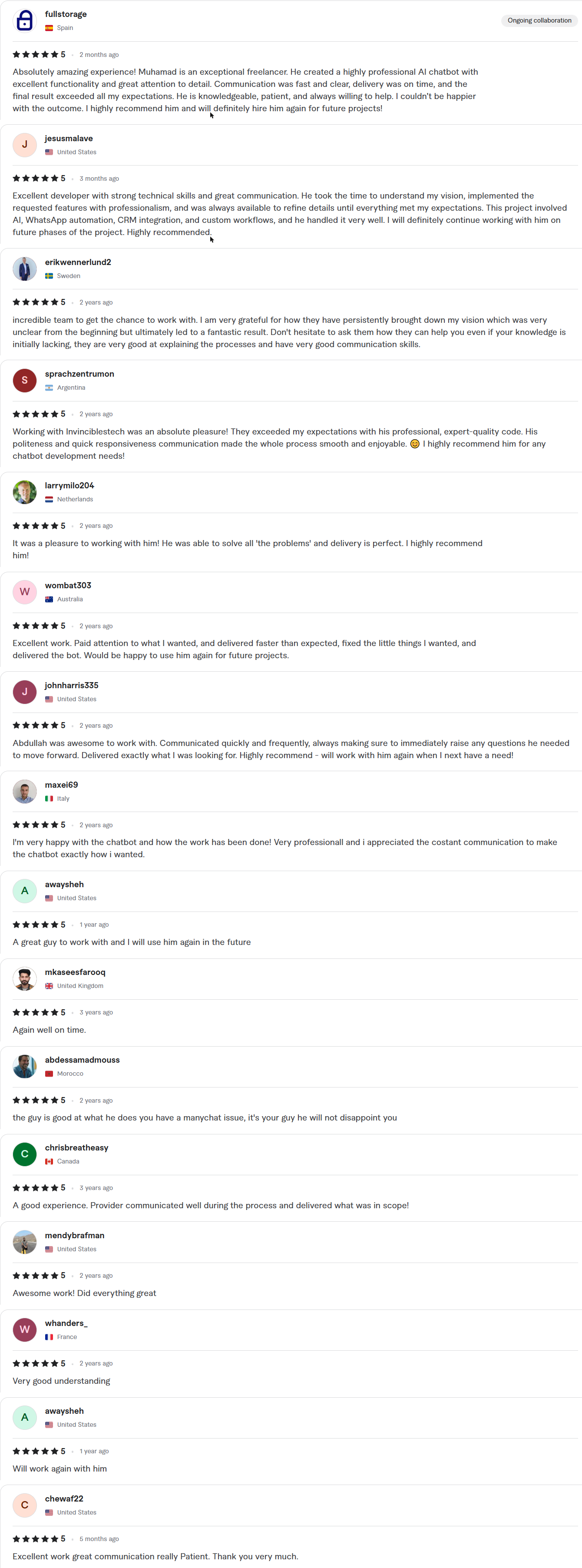
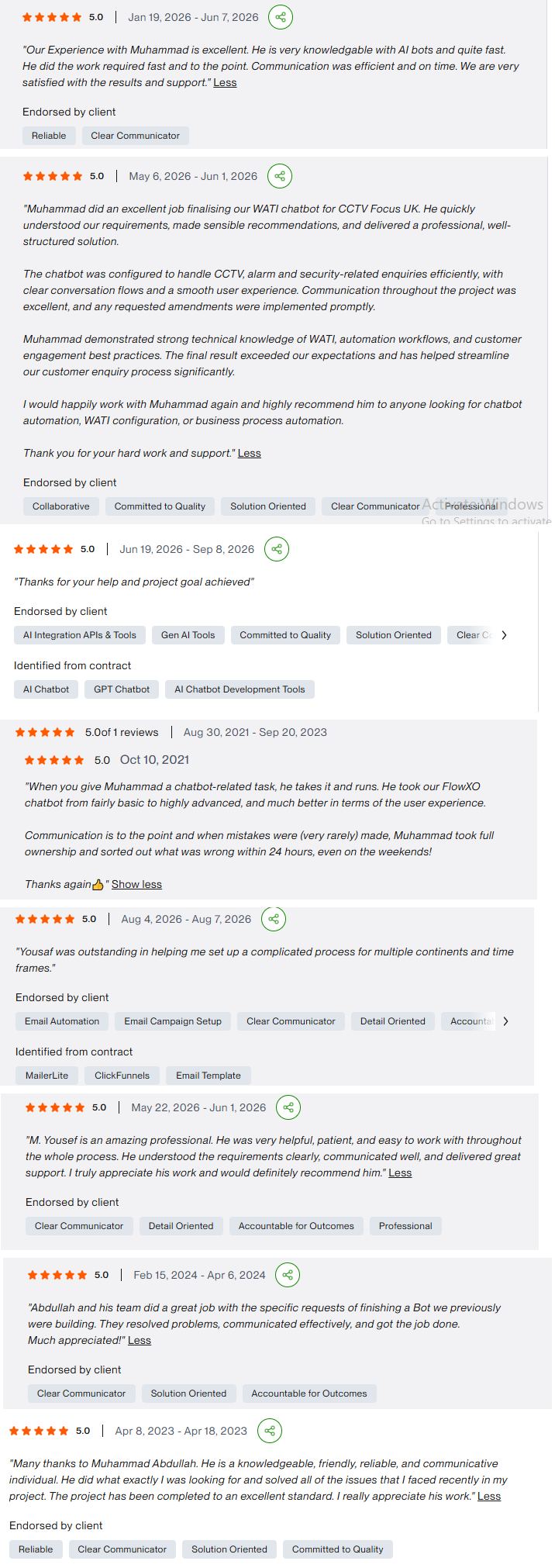
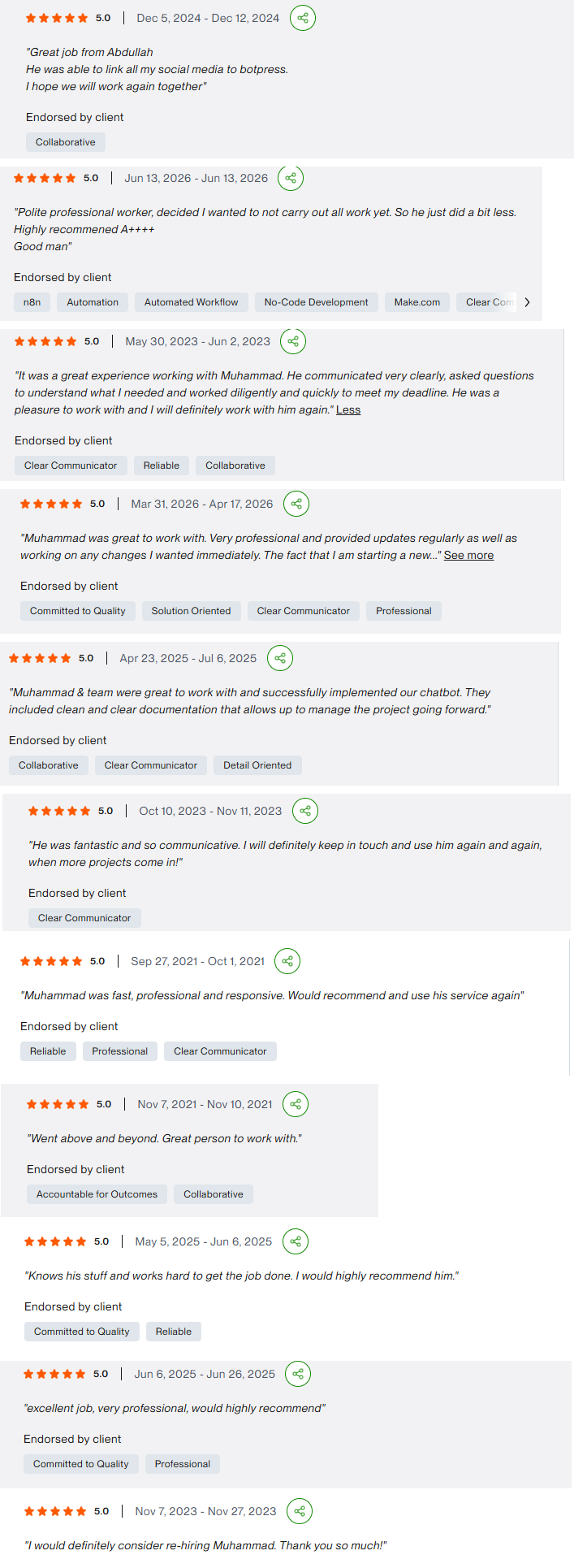
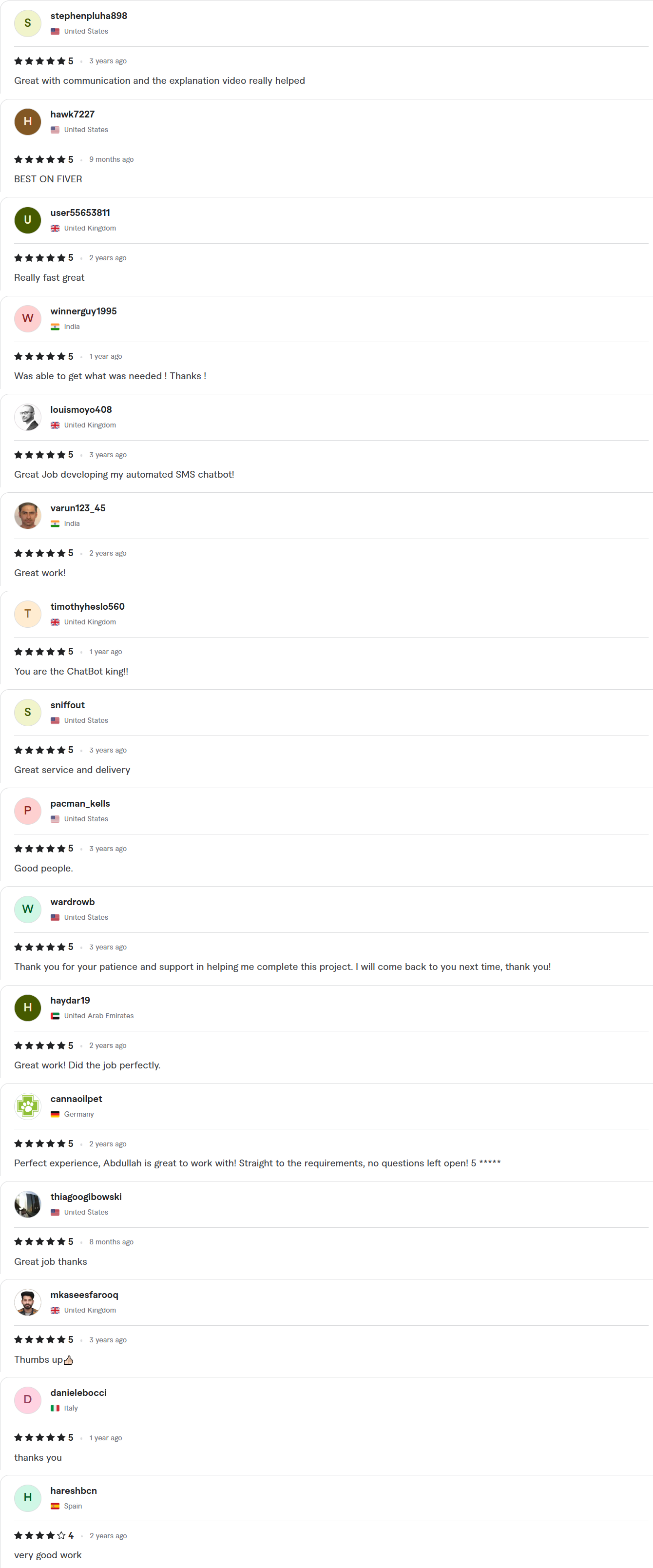
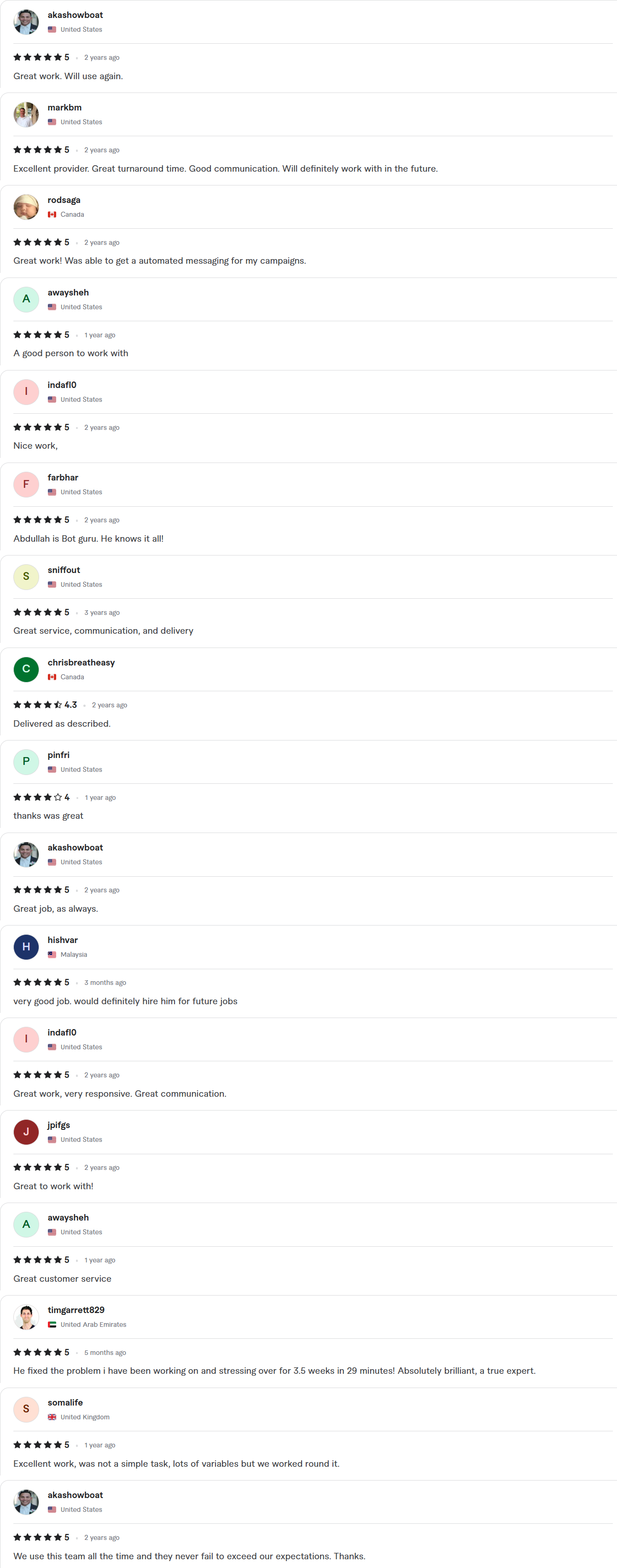
Client Reviews
5.0 average rating on Upwork and Fiverr
Answers, before you book.
Quick answers to the questions we hear most from healthcare providers.
Does the bot give medical advice or triage symptoms?
No. It answers from information you approve, collects details and routes requests. It does not give medical advice, triage symptoms or discuss results, and it passes those topics to your staff. If someone describes an emergency, it directs them to emergency services.
How is patient information handled?
We agree with you, before anything is built, how patient details may be handled, which systems they may enter and which agreements apply to your organisation. We do not claim a compliance status on your behalf, and we work within the requirements you set.
Can it work across several sites and departments?
Yes. Requests are routed by site, department or service line using rules you set, and the directory it answers from is the one you approve and keep up to date.
What happens to calls and chats it cannot handle?
They go to a person with the conversation or a call summary, so the patient does not repeat themselves. You define the triggers, including a patient simply asking for a person.
Do I need to replace our scheduling system?
No. It works with the system you already use where it offers an interface, and with your existing channels such as website, phone and WhatsApp. A CRM is added only if you want one.